 Admin
Admin Everyone blames hard water — but soft water has its own set of sneaky hair problems. If your hair feels limp, greasy, or lifeless, read this first.
You installed a water softener or moved to a new city with naturally soft water — and expected your hair to transform. But instead, it looks worse. Flat. Greasy. Lifeless. No volume, no bounce. Sound familiar? You’re not imagining it. Soft water hair problems are real, underreported, and affect thousands of Indians — especially those who’ve switched from hard water or moved between regions. This guide breaks down every problem, explains the science, and gives you practical fixes that work for Indian hair types.
First, What Is Soft Water — And Is It Common in India?
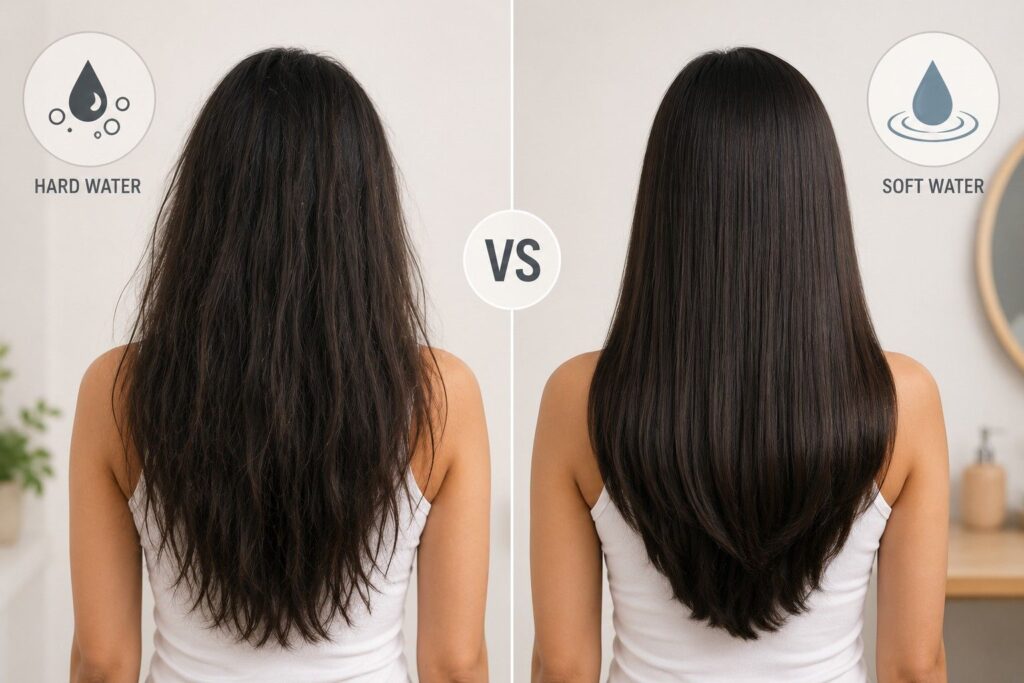
Soft water is water that contains very low concentrations of dissolved minerals, particularly calcium and magnesium. While hard water (common in Delhi, Gurgaon, Jaipur, Hyderabad) is known for leaving white deposits on taps and making hair brittle, soft water sits at the other extreme — with almost no mineral content.
In India, naturally soft water is found in coastal and hill regions — parts of Kerala, Assam, Himachal Pradesh, and the Northeastern states. But increasingly, soft water is being created artificially — through water softeners installed in homes and apartments, especially in Tier-1 cities where residents are fighting back against hard water damage. This is where the problems start.
The issue isn’t that soft water is “bad.” The issue is that most people don’t adjust their hair care routine when switching to soft water — and the results can be just as frustrating as hard water, only in the opposite direction.
| Feature | Hard Water Hair | Soft Water Hair |
|---|---|---|
| Texture | Rough, dry, brittle | Limp, over-soft, slippery |
| Scalp feel | Dry, flaky, itchy | Greasy, heavy, oily |
| Product lather | Minimal foam | Excessive foam/buildup |
| Volume | Can look puffy/frizzy | Flat, no body |
| Hair colour | Fades fast, brassy | Even, longer lasting |
| Shine | Dull, coated look | Can look greasy/wet |
The Problems
9 Soft Water Hair Problems (With Science-Backed Fixes)
01 Most Commona
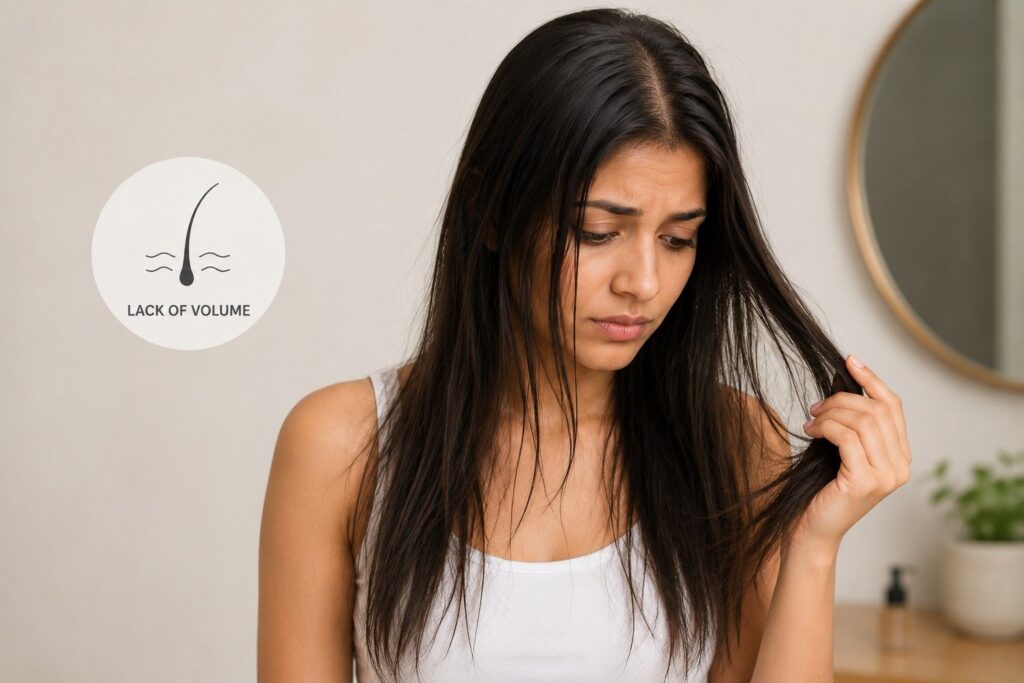
Your Hair Feels Limp, Flat, and Has Zero Volume
This is the #1 complaint from people switching to soft water. When water lacks minerals, it interacts differently with your hair shaft. Hard water’s calcium deposits, despite being damaging, did one accidental thing — they added a bit of structural “grip” to each strand. Soft water removes this entirely.
Your hair cuticle opens slightly more in soft water, and without protein-based support, strands cling together. The result? Hair that lies completely flat against your head, unable to hold any style or volume — a frustrating experience for Indian women with naturally thick hair who expect bounce and body.
✦ How to Fix It
- Switch to a volumising shampoo with proteins (keratin or wheat protein)
- Use a lightweight, root-lifting conditioner — apply only from mid-length to tips
- Try a sea salt spray after washing for grip and texture
- Blow dry with a round brush to lift roots away from the scalp
- Cut back on conditioner amount by 50% — soft water needs far less
02 Scalp Issue
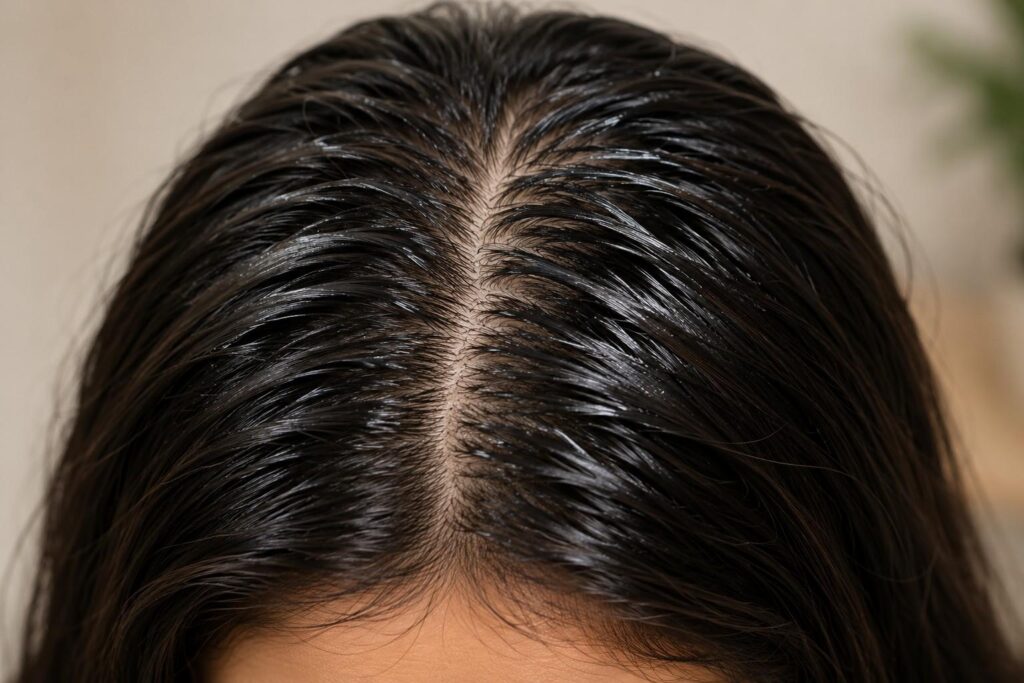
Scalp Becomes Greasy Within Hours of Washing
You wash your hair in the morning, and by afternoon it looks like you haven’t showered in days. Soft water doesn’t strip your natural oils the way hard water does — which sounds good in theory. But if you’re used to hard water, your scalp has been overproducing sebum to compensate for constant dryness. When soft water arrives, the stripping stops, but the oil production hasn’t slowed down yet.
Add to this the fact that soft water causes shampoo to lather very aggressively — leading most people to rinse less thoroughly, leaving a film of product on the scalp that traps even more oil.
✦ How to Fix It
- Rinse your hair for twice as long as you normally would
- Use a clarifying or balancing shampoo once a week
- Reduce washing to every 2–3 days to allow sebum regulation
- Apply a few drops of dry shampoo at roots between washes
- Avoid conditioning your scalp area completely
03 Product Buildup
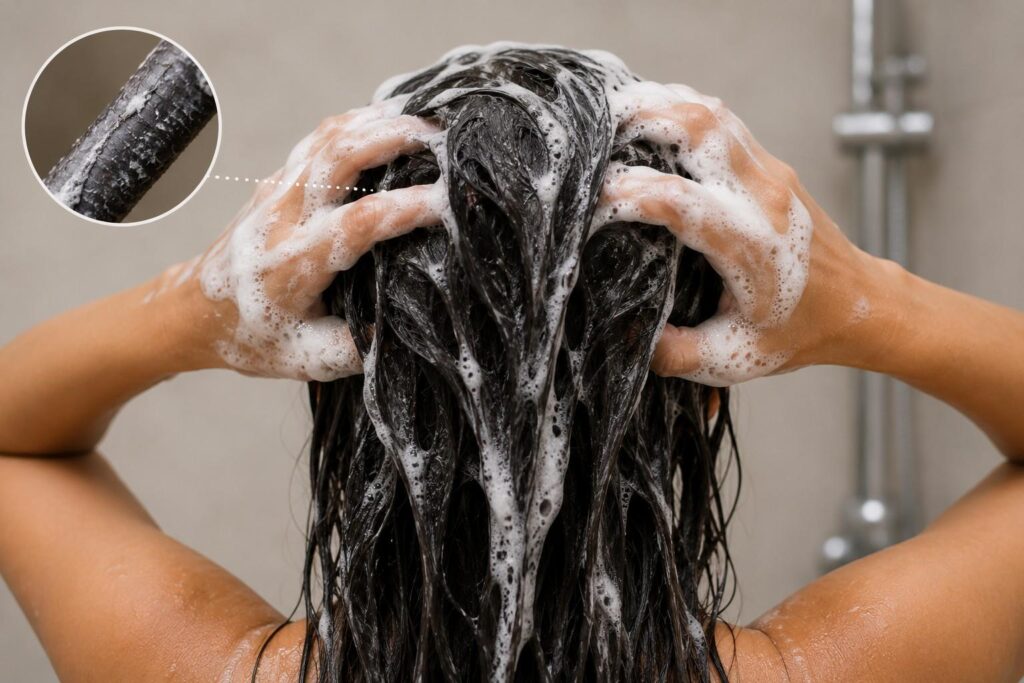
Hair Products Build Up Faster and Feel Heavier
Soft water causes shampoos and conditioners to lather far more generously than hard water does. This feels luxurious at first — that thick, creamy foam feels like it’s doing more work. But here’s the trap: that excess foam means you’re using more product than your hair actually needs, and soft water has difficulty rinsing those surfactants and silicones away completely.
The result is a progressive buildup of product residue on each strand — making hair feel sticky, heavy, and increasingly dull over time. Indians who use coconut oil, amla, or shikakai-based products are particularly prone to this, as these ingredients can also accumulate.
✦ How to Fix It
- Use only a coin-sized amount of shampoo — not the usual dollop
- Do a monthly clarifying wash with a sulphate shampoo
- Avoid silicone-heavy conditioners and serums
- After oiling, pre-wash with a small amount of shampoo before full wash
- Try an apple cider vinegar rinse (1:3 ratio) monthly to remove buildup
04 Fine Hair Alert
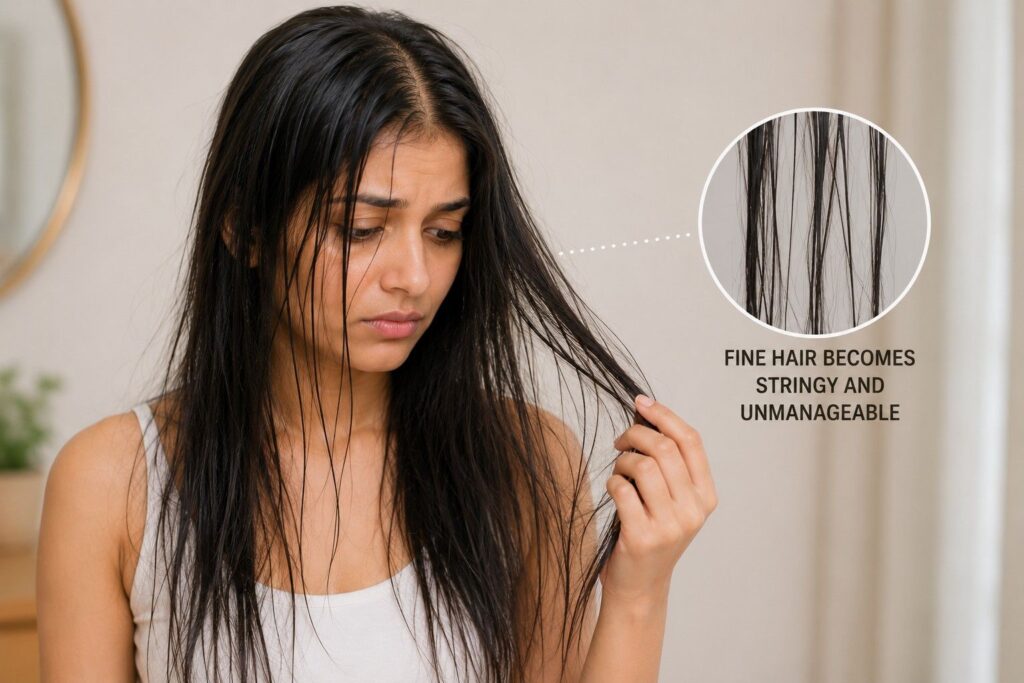
Fine Hair Becomes Stringy and Unmanageable
Those with fine or thin hair — a common concern especially among Indian women in their 20s and 30s — bear the brunt of soft water’s downsides. Without any mineral structure, fine hair strands become almost too smooth. They can’t grip each other or hold a style. Hair looks plastered to the scalp, and any styling product makes it appear worse, not better.
This is the cruel irony: soft water is technically gentler on strands, but for fine hair, “gentler” translates to “no grip whatsoever.” Many people mistake this for hair thinning or hair loss, when the root cause is simply water chemistry.
✦ How to Fix It
- Use a protein-based shampoo (look for hydrolysed wheat or silk protein)
- Skip conditioner entirely, or use an ultra-light leave-in mist
- Try a rice water rinse — a popular Indian remedy that adds protein and body
- Get layers cut into your hair to add movement
- Use texturising powder at roots for instant lift
05 Curl Health
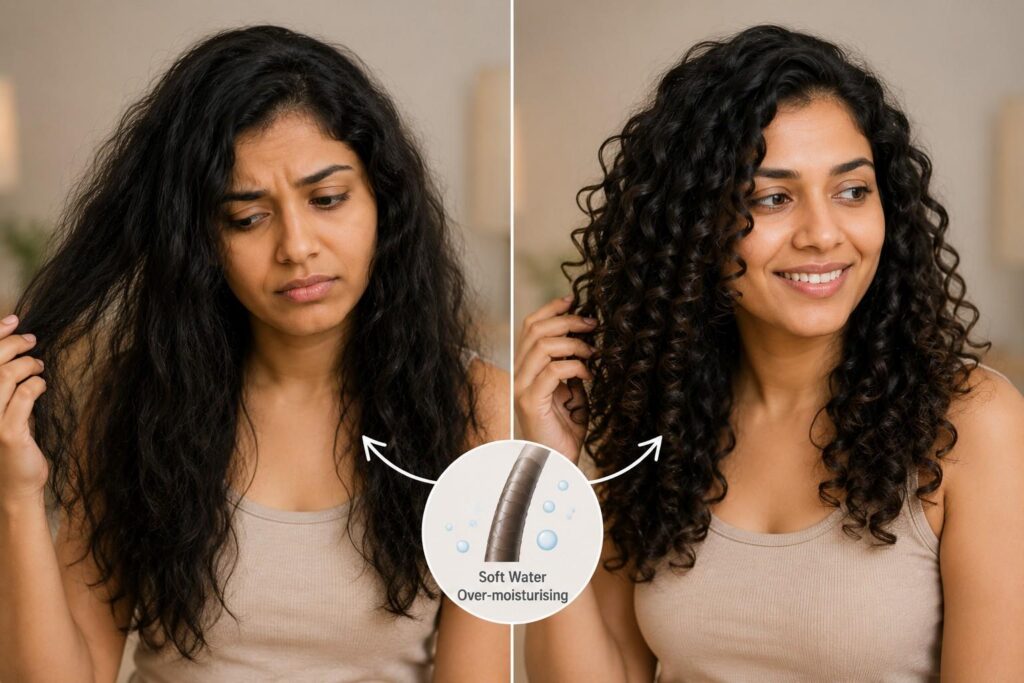
Curls and Waves Lose Their Definition and Bounce
If you have wavy or curly hair — incredibly common across South India, Maharashtra, and among Indian women of diverse ethnicities — soft water can be particularly confusing. While hard water causes curls to frizz and go coarse, soft water can cause them to lose definition entirely, appearing stretched, pulled-down, or clumped together without form.
Curls rely on a balance of moisture and protein. Soft water shifts this balance sharply toward the moisture side, causing hygral fatigue — a condition where over-moisturised hair loses its elasticity and curl pattern. Your curls may feel soft to the touch but look droopy and undefined.
✦ How to Fix It
- Add a protein treatment (egg mask or keratin mask) every 2–3 weeks
- Use a curl cream with hold — not just a moisturising one
- Try “scrunching out the crunch” after diffusing for defined curls
- Reduce deep conditioning frequency — once every 2 weeks is enough
- Use a lightweight gel to restore curl structure after wash
Did You Know? The Routine Reset Rule
The most common mistake when switching to soft water is continuing to use your hard-water routine. Those heavy oils, rich conditioners, and large amounts of shampoo that barely worked against mineral buildup will now overwhelm your hair completely. Soft water requires a full product and habit reset — often reducing quantities by 40–60% across the board.
06 Colour Treated
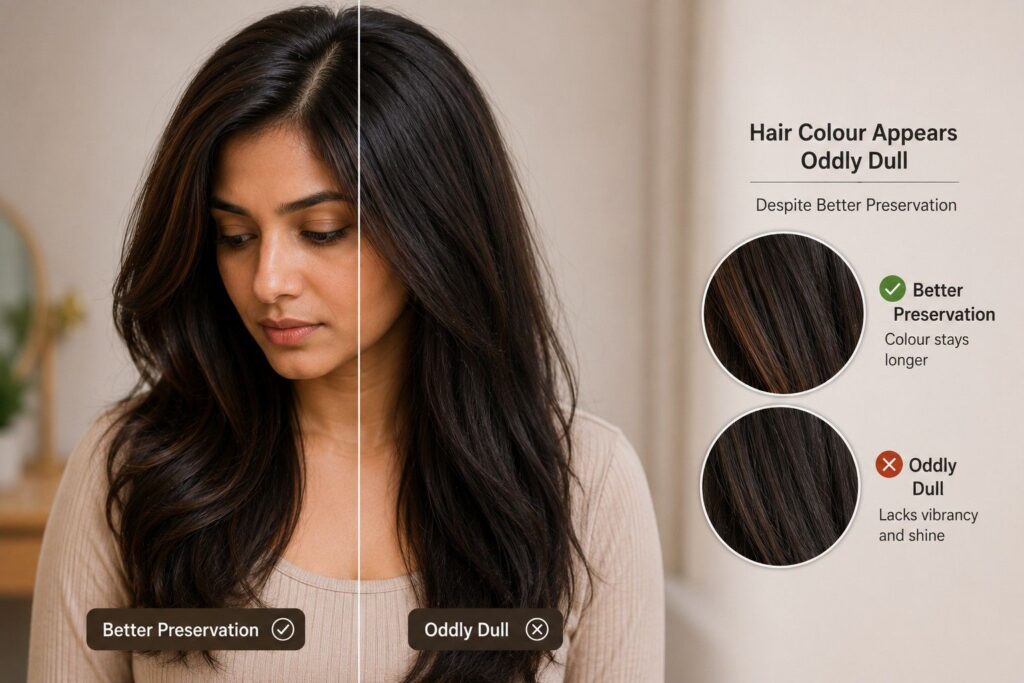
Hair Colour Appears Oddly Dull Despite Better Preservation
Here’s a paradox: soft water actually preserves hair colour better than hard water (no minerals to oxidise pigment). But many colour-treated Indians find their hair looks dull and flat after switching. The problem isn’t the colour itself — it’s that soft water makes hair too smooth and light-reflective in a flat way, rather than giving the dimensional shine that makes colour pop.
Additionally, if your stylist used products calibrated for hard water, the residues left behind can interact differently in soft water, leaving an odd, slightly waxy feel that mutes the vibrancy of your colour.
✦ How to Fix It
- Use a colour-safe, sulphate-free shampoo — avoid heavy conditioning masks
- Finish rinses with cool water to seal the cuticle and boost shine
- Use a toning shampoo or gloss treatment monthly
- Inform your stylist about your water type before appointments
- A light shine serum (not oil) applied to dry hair adds dimension
07 Scalp Sensitivity
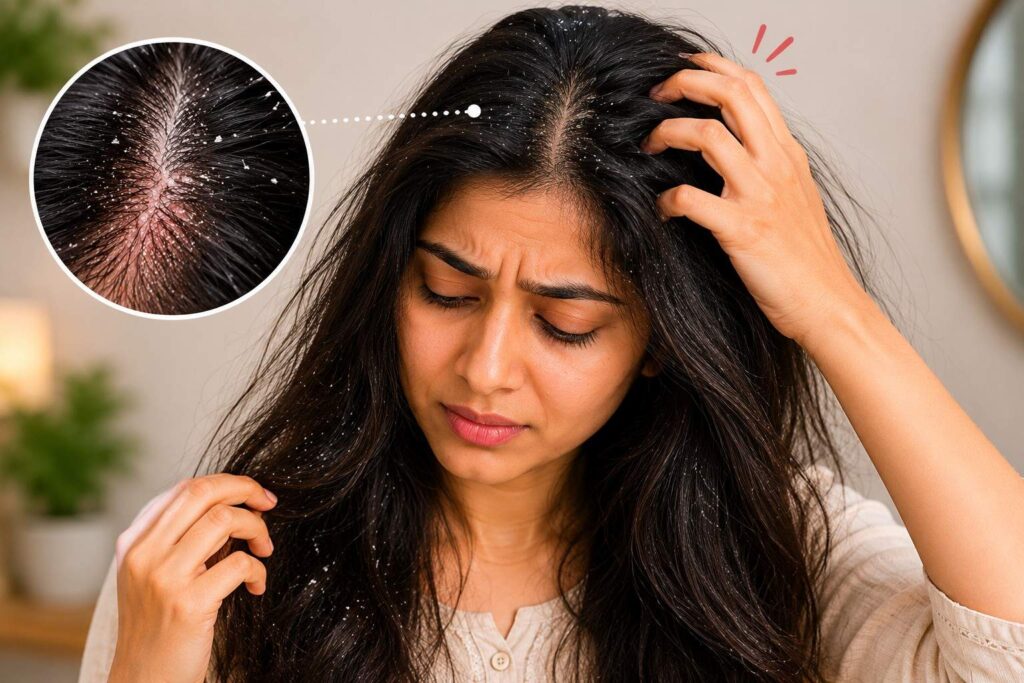
Hair Colour Appears Oddly Dull Despite Better Preservation
While hard water typically causes dandruff through mineral-induced dryness, soft water can cause a different kind of scalp disruption. When shampoo doesn’t rinse properly due to over-lathering, leftover surfactants sit on the scalp and disrupt its natural microbiome. This can cause irritation, mild flaking, or an itchy feeling that is easy to confuse with dandruff.
In India’s humid climate, this problem is compounded — an excess of product on the scalp in hot, humid conditions creates the perfect environment for fungal overgrowth, especially Malassezia (the yeast responsible for dandruff).
✦ How to Fix It
- Use a gentle, pH-balanced scalp shampoo (pH 4.5–5.5)
- Rinse with extra-cold water at the end of your wash
- Use a neem oil scalp treatment weekly — an Ayurvedic antifungal
- Try a diluted tea tree oil scalp massage before washing
- Avoid heavy scalp serums or tonics — they’ll sit without absorbing
08 Drying Problem
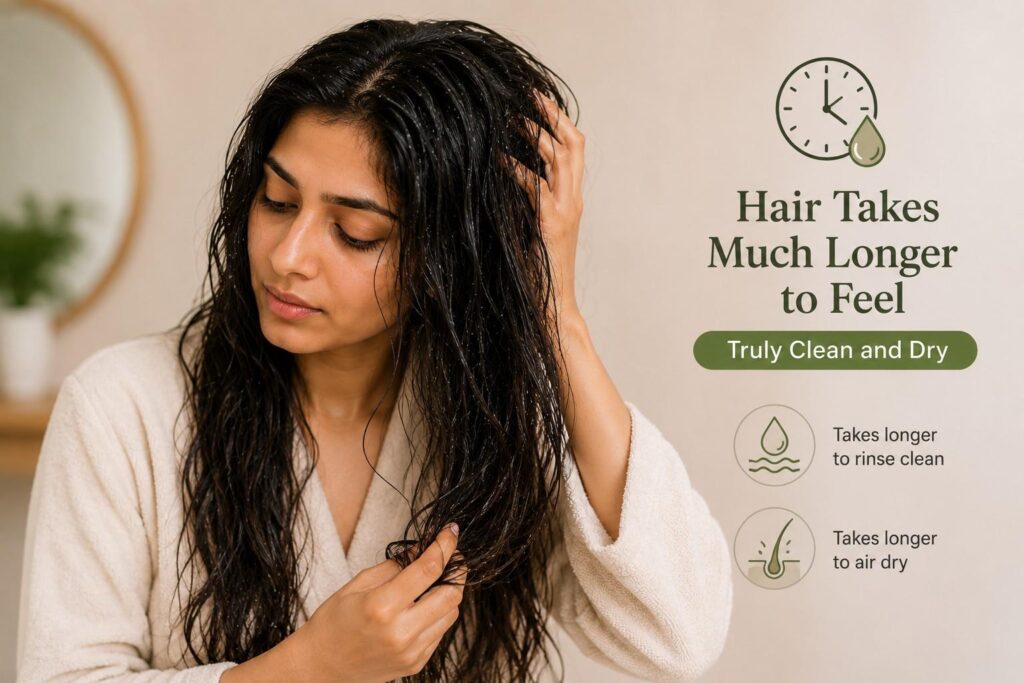
Hair Takes Much Longer to Feel Truly Clean and Dry
One of the lesser-discussed soft water hair problems is how your hair behaves after washing. Because soft water penetrates the hair shaft slightly more readily, hair often feels wet or tacky long after washing. The cuticle, left without mineral coating, stays slightly more open — absorbing humidity from the air (a serious issue in coastal Indian cities like Mumbai, Chennai, or Kolkata).
The result: hair that takes ages to dry, feels slightly damp or heavy even when dry, and frizzes readily in monsoon weather. This is frequently mistaken for “damaged hair” when it’s simply a reaction to soft water’s chemistry.
✦ How to Fix It
- Always finish with a cold-water rinse to close the cuticle
- Use a lightweight anti-humidity serum before blow-drying
- Do not wrap hair in a towel — use a microfibre hair wrap or old T-shirt
- Diffuse or air-dry in a well-ventilated area, not an AC room (too much moisture)
- A light hold hairspray after styling can lock moisture out in humid months
09 Oiling Routine
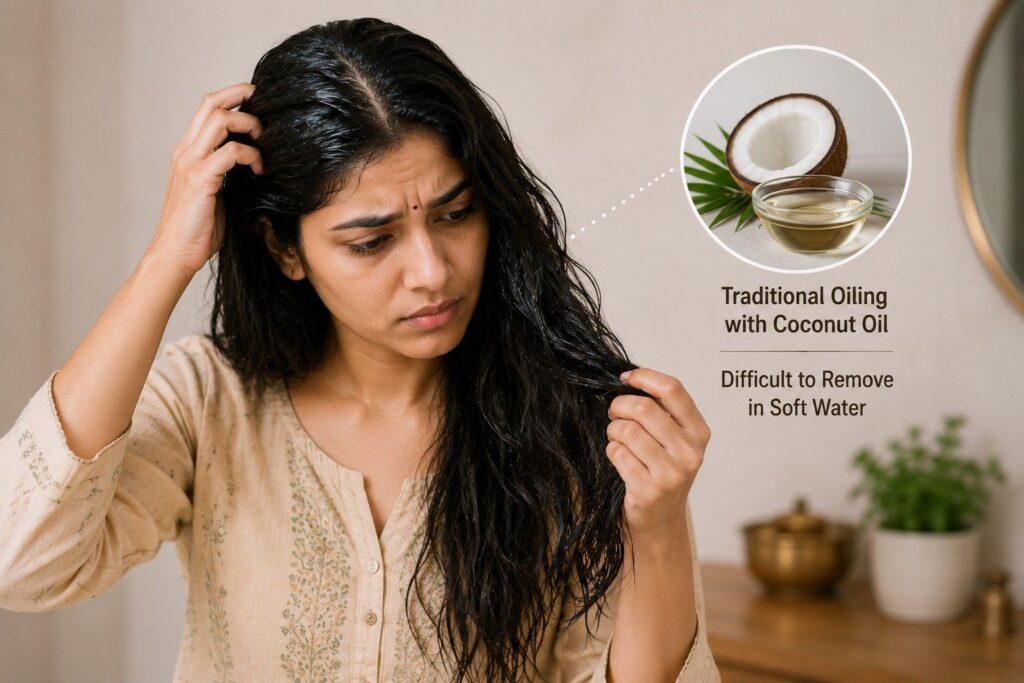
Traditional Indian Hair Oiling Becomes Harder to Remove
Hair oiling is a sacred ritual for millions of Indians — from coconut oil in Kerala to mustard oil in Punjab. But soft water creates a unique problem with oiling routines: because shampoo lathers so richly and aggressively in soft water, it can create a soapy film that traps oil against the hair shaft rather than lifting it away. The result is hair that feels half-washed — some areas feel over-conditioned and greasy while others feel like the oil was never removed.
This inconsistency is deeply frustrating for those who rely on oil treatments as a cultural cornerstone of hair care.
✦ How to Fix It
- Do a “pre-poo” — apply a tiny amount of shampoo to dry oiled hair before wetting it
- Use warm (not hot) water to open the cuticle before washing
- Double-shampoo if using heavy oils like castor or mustard
- Switch to lighter oils like argan or jojoba for regular use in soft water areas
- Allow oil to sit for max 1–2 hours; overnight oiling increases buildup risk
Your Complete Soft Water Hair Routine for India
Adjusting to soft water isn’t just about fixing one problem — it requires rethinking your entire routine. Here are the pillars of a soft-water-friendly hair care approach designed for Indian hair types and climate:
🧴Reduce Product Quantity
Use 40–50% less shampoo and conditioner than you used with hard water. Soft water multiplies lather — you need far less.
🥚Protein Masking
A weekly egg or keratin mask restores the structural balance that soft water removes. Apply for 20 mins, rinse with cool water.
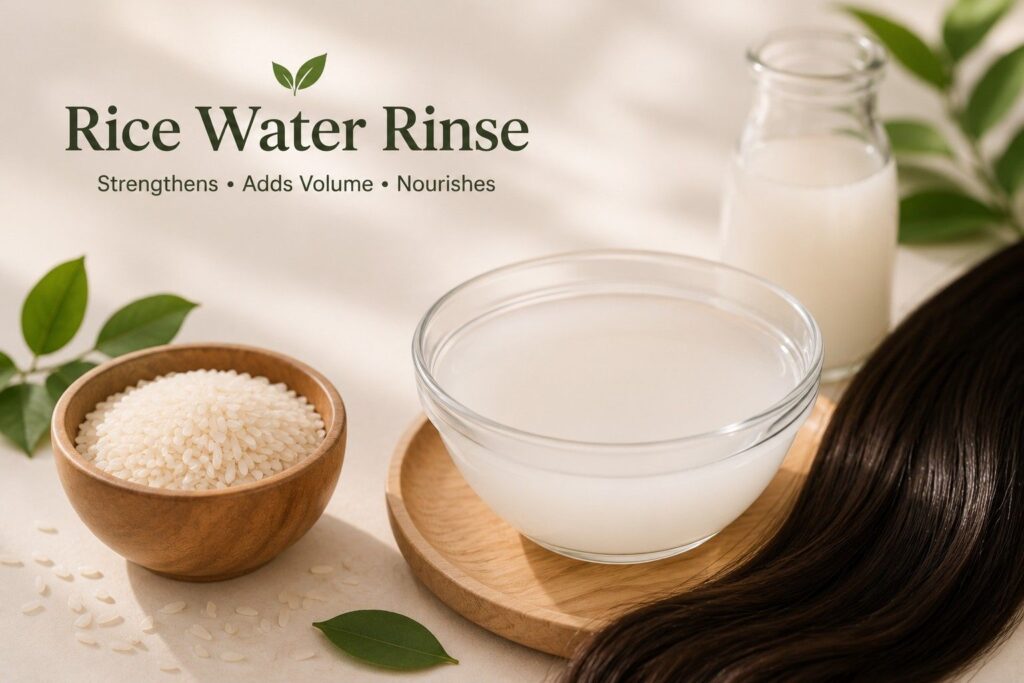
🌾Rice Water Rinse
Fermented rice water (chawal ka paani) has been used in Asian hair traditions for centuries. It adds inositol and protein, naturally firming soft hair.
🚿Rinse Thoroughly
Rinse twice as long as you think you need to. Soft water holds product in — only relentless rinsing clears the slate.
💧Cold Final Rinse
End every wash with 30 seconds of cold water. This seals the cuticle and reduces frizz, humidity absorption, and greasiness.
🌿Ayurvedic Balance
Shikakai, reetha, and amla are naturally balanced for Indian water. These gentle cleansers don’t over-lather in soft water the way synthetic shampoos do
For more information:https://hairglowguide.com/15-best-protein-foods-for-hair-growth-in-india/
https://hairglowguide.com/grow-hair-back-with-food-indian-diet-guide/
https://hairglowguide.com/can-liver-problems-cause-hair-loss/
Frequently Asked Questions About Soft Water Hair Problems
Is soft water actually bad for hair in India?
Soft water is not inherently bad for hair — it’s actually structurally gentler than hard water, and produces fewer long-term damage issues like breakage or mineral buildup. However, soft water requires a completely different hair care routine. Without proper adjustment, it causes cosmetic problems like limpness, greasiness, and product buildup that can feel just as problematic as hard water damage. The key is adapting your routine to match the water chemistry.
Why did my hair get greasy after installing a water softener?
This is the most common experience after installing a water softener. Your scalp was likely overproducing oil to compensate for hard water’s stripping effect. When soft water stops that stripping, the excess oil production continues — and soft water also prevents products from rinsing fully, adding a layer of product residue. Both effects cause greasiness. The solution is to reduce product quantities, rinse longer, and wash slightly less frequently to allow your scalp to self-regulate over 3–6 weeks.
How do I know if my hair problems are from soft water or hard water?
Hard water causes dryness, frizz, dullness, and brittle texture — hair that feels rough and looks coated. Soft water causes the opposite: limp, flat, over-soft, greasy, or product-heavy hair. Check if your shampoo lathers easily (soft water = very easy lather) or if water leaves white deposits on your bathroom surfaces (hard water = white deposits). You can also use an inexpensive TDS (Total Dissolved Solids) meter available on Amazon India to check your water mineral content.
Can soft water cause hair fall in India?
Soft water does not directly cause hair fall or hair loss. However, the cosmetic problems it causes — heavy product buildup, clogged scalp from unrinsed shampoo, and excess sebum — can, over time, affect scalp health and potentially slow healthy hair growth. Additionally, when hair feels limp and flat, breakage from frustrated over-brushing and heat styling can increase. If you’re experiencing significant hair fall, consult a trichologist — the cause is likely nutritional, hormonal, or genetic, not water-related.
Which Indian cities have naturally soft water?
Cities and regions in India with naturally softer water include Thiruvananthapuram, Kochi, Guwahati, Shillong, Shimla, Darjeeling, and several towns in the Northeastern states. These areas draw from rainwater-fed rivers and reservoirs with lower mineral content. In contrast, Delhi, Gurgaon, Jaipur, Ahmedabad, and parts of Hyderabad and Bengaluru have notably hard water. Residents in soft water regions should be aware of the issues discussed in this article when adopting hair care routines.
The Bottom Line on Soft Water Hair Problems
Soft water gets an undeservedly good reputation in the hair care world — especially in India, where the battle against hard water damage dominates conversations. The truth is more nuanced: soft water is neither your hero nor your villain.
For Indian hair types, especially thick, curly, or oily-scalp-prone hair, soft water presents a genuinely different set of challenges. Limpness, greasiness, product buildup, and lost curl definition are all real — and frustrating. But they are entirely fixable once you understand the chemistry and adapt accordingly.
The single most important thing you can do? Reset your routine entirely when your water changes. Use less product. Rinse longer. Rebalance with protein. And lean into India’s richest hair care heritage — rice water rinses, neem scalp treatments, and shikakai washes — which have been quietly calibrated for South Asian hair and varied Indian water conditions for centuries.
Your water doesn’t have to be your enemy. Understand it, and it becomes your most underrated hair care tool.

 Admin
Admin